They quit around week two, or right after the first dose increase, for a reason that has nothing to do with willpower and everything to do with the stomach. Nausea is the most common reason people stop a GLP-1 early. It is also the most predictable, which makes it the one part of this you can plan for, and the part RxPros builds into the vial.
A large share of people who start a GLP-1 for weight loss are no longer taking it a year later, and much of that drop happens in the first weeks, before the medication has had a fair chance to do anything visible.
Now put that next to the trials. In the published semaglutide and tirzepatide studies, where the dose climbed on a fixed, slow schedule and people had clinical contact the whole way, only a small single-digit percentage stopped because of side effects.
Same molecule. Wildly different outcome. The difference is not the drug. It is everything wrapped around it.
Both figures describe the underlying molecules as studied and dispensed generally. They are not RxPros patient outcomes, and individual experience varies.
GLP-1 medication does three things at once. It acts on appetite signalling in the brain, it quiets what patients call food noise, and it slows down how fast your stomach empties. That third one is a large part of why you stay full on less food. It is also, precisely, why you feel queasy.
So the nausea is not the medication misfiring, or a bad batch, or your body rejecting it. It is the same mechanism you are paying for, felt from the inside. Which is why the answer is almost never to stop, and almost always to go slower and give the gut time to adapt. In most people it does adapt, and the queasiness fades over the following weeks even as the appetite effect stays.
In the semaglutide weight-loss trials, roughly four in ten participants reported nausea at some point. Most of it was mild to moderate, most of it clustered around dose increases, and most of it settled.
Reported as a headline, that sounds alarming. Understood as a schedule, it is something you can prepare for.
Nausea on a GLP-1 is not random. It tracks the titration. It arrives in the days after you go up a dose, and it comes back every time you go up again. Between the steps, most people feel fine.
Which means the hard weeks are known in advance. They are the ones on this strip.
General pattern reported across GLP-1 dose-escalation schedules. Your provider sets your actual titration, and individual experience varies.
Every program in this category knows the first eight weeks are where people are lost. Very few do anything about it in the product itself. You get the molecule, a titration schedule, and a wish of good luck.
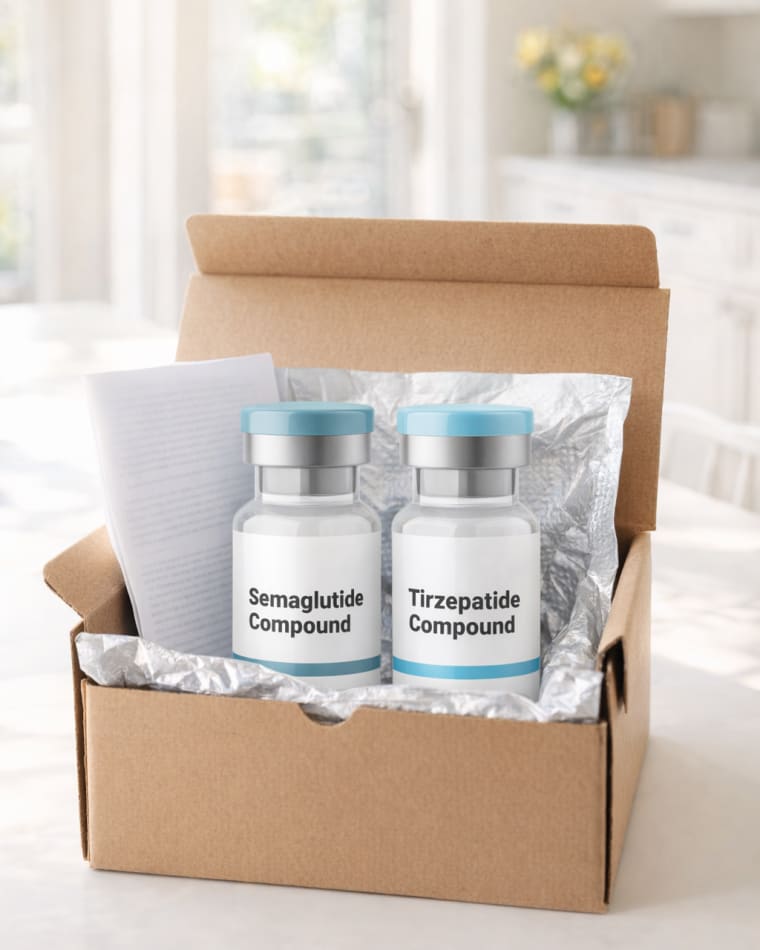
RxPros compounds three things into the vial alongside the medication, chosen for that stretch specifically.
B6 is long established as a nausea remedy in other clinical settings. It is the standard first-line option in pregnancy, which is the most nausea-studied situation in medicine. It is included here for the same reason, at the point in treatment where nausea is most likely.
When appetite drops this sharply, total nutrient intake drops with it. B12 supports energy and nerve function through exactly that stretch, and deficiency is common in people losing weight quickly.
An amino acid included in the tirzepatide preparation to support overall tolerability during treatment.
Both medications arrive compounded this way, and it does not cost extra, because it is not an add-on. It is how the preparation is made. Zofran can also be added at checkout if you want a rescue option on hand for the harder days.
None of which makes side effects impossible, and anyone who tells you otherwise is selling you something. What it means is narrower: tolerability was designed into the formulation rather than left entirely to you.
None of this is exotic. It is the practical layer most people work out by month three, which is a shame, because month one is when they needed it.
One line of caution, and then we will stop. Severe stomach pain that will not settle, vomiting that stops you keeping fluids down, or yellowing of the skin or eyes are not the ordinary early-weeks queasiness. Those are reasons to contact your provider rather than wait it out.
Including the weeks where the formulation matters most, and the month where the other kind of quitting starts.
Everything above is about how it feels. There is a second reason people stop, and the two are connected in a way worth seeing plainly.
GLP-1 dosing steps up over months. That is how it is designed to work. In most programs, every one of those steps also raises your rate, usually around month three and again around month six. So consider what happens to someone in a dose-priced program in the week their dose goes up. They feel the worst they have felt in a month, and they are charged more for it, in the same seven days. Results have not caught up yet. That is where the quiet quitting happens, and it is rarely the medication's fault.
We cannot make the titration painless. We can make sure it is not also the week your bill goes up.
Climb modeled on standard pricing that rises with your dose. Month six is where the climb peaks, and where a lot of people quietly quit.
The tolerability formulation is included in both, at every dose, and the price does not move when the dose does.
Prescribed only if you qualify
Not every GLP-1 program includes the same things. Here is the whole picture.
Brand-name figure is published manufacturer list pricing. "Typical telehealth" reflects advertised rates across GLP-1 telehealth brands and the dose-based pricing structure most of them use. Twelve months at $89.97 is $1,079.64, against $16,188 at the brand-name counter.
The part most programs bury. It is here, above the last button, on purpose.
For most people it is worst in the days after a dose increase and settles over the following weeks as the gut adapts. It then tends to return briefly at each step up, and to fade as the dose stabilises.
For a minority it does not settle, and that is a real conversation to have with your provider rather than something to endure quietly.
No, and we will not claim that. B6, B12 and glycine are compounded in to support tolerability through the weeks where it is hardest. They are not a guarantee against side effects, and individual experience varies.
The honest version of the claim is this: most programs give you the molecule and nothing else. This one puts something in the vial aimed at the reason people quit.
Then you stay on it. Holding a dose, or stepping back down and climbing again more slowly, is an ordinary clinical adjustment.
It also costs you nothing here, because the price is the same at every dose. In a dose-priced program the incentive quietly runs the other way.
Zofran can be added at checkout, and your provider can be messaged about symptoms at any point during the plan. Most of what helps, though, is the unglamorous list further up this page: smaller meals, less fat, steady fluids, and not rushing the climb.
It is the same molecule, prepared differently. A compounding pharmacy makes it to an individual prescription rather than it being mass-manufactured and sold as a branded pen. RxPros uses the pure base form of the molecule, not the cheaper salt form some sellers substitute.
It is not FDA-approved, and it has not been through FDA review for safety, effectiveness, or manufacturing. That is the honest trade-off behind the price difference, and it is why a licensed provider has to evaluate you first.
No. The price at your lowest dose is the price at your highest: $89.97 for semaglutide, $119.97 for tirzepatide, for the entire plan.
Tirzepatide acts on two gut-hormone receptors instead of one and showed larger average reductions in trials, which is why it costs more. Semaglutide has the longer track record. Both are compounded with the same B6, B12 and glycine.
The provider reviewing your intake is the right person to make that call, based on your history rather than on price.